Someday I want to see a scan of the pre-teen brain during a class transition. Want to bet it lights up like fireworks? But whatever is going on in there, my bouncy kids need help to focus their bodies and minds after all the super exciting things that happen in the 3-minute walk from their classroom to my STEAM art room. I learned a new procedure for starting class in a PD last year and tried it super quick... darn if it didn't work better than anything I've done so far (like everything plus the kitchen sink). Here are the ABCs of the procedure step by step. (This sequence was created based on the work of Hyde and Charles, Sequoia Union High School District. 2016.) A) S cout for Respectful Behaviors. Invite 2 reliable students into the room to tally respectful behaviors they see as the class enters. They're the kids who can stand on the line with their arms down, their bodies calm, and their voices off modeling appropriate line behaviors and this...
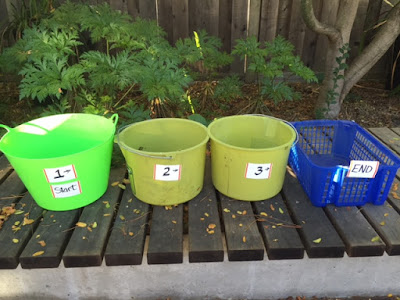
The students in my elementary art classes all want to clean brushes -- and they usually do it badly--each one making a different kind of mess in their own special way. Not to mention all the water they wasted. Without a sink in the room that means wasting water hauled in buckets across campus from the sink in the teacher's room. One day, while hauling water and dreaming of being a child again under the free and open skies of summer camp, a solution popped into my head.... how simple! (Note to parents: summer camp really does prepare a child for life). At camp each camper washed her own dishes -- rinsing, washing and rinsing again down a conga line of 3 buckets. In the art studio it goes like this: Line up the early finishers with brushes in hand. Set the pace with a quick round of "Twinkle Twinkle Little Star" (it takes about 20 seconds). Students sing again while 1-2 kids move down the line swishing their brush in each bucket along with the song. ...
T his article was adapted for middle school students from an original article called “The Cutting Edge Physics of Jackson Pollock” by Lisa Grossman (Wired Magazine. July 2011). You can read the original article here: https://www.wired.com/2011/07/pollock-physics/ For more about Jackson Pollock take a look at the Khan Academy Video: "Why is That Important: Looking at Jackson Pollock. " Untitled. 1948-1949. Jackson Pollock. Drip Paintings Jackson Pollock was an artist who was famous for his drip paintings. Scientists now think that he was using art to explore an area of science called fluid dynamics years before scientists even thought to study it. "His particular painting technique essentially lets physics be a player in the creative process," said physicist Andrzej Herczynski of Boston College, coauthor of a new paper in Physics Today that analyzes the physics in Pollock's art. "To t...


Comments
Post a Comment